
Il y a des trajectoires qui sentent la communication. Et puis il y a celles qui sentent la poussière.
Avni Nasufoski appartient à la seconde catégorie.
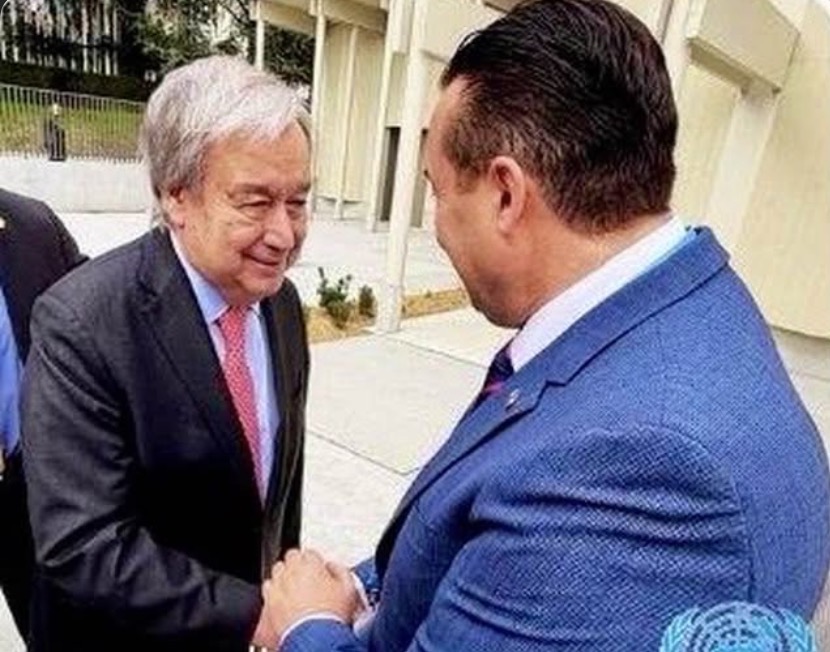
Avant les salons feutrés des Nations Unies à Genève, avant les poignées de main calibrées avec António Guterres, il y a eu les silos. La poussière. Le travail brut. Rien de très “diplomatique”. Et c’est précisément là que l’histoire devient intéressante.
Parce que ce type-là ne sort pas d’une école de diplomatie. Il n’a pas été poli à coups de stages dans les chancelleries. Il arrive d’ailleurs. Littéralement.
Adolescent débarqué en Suisse, aujourd’hui enraciné entre la bourgeoisie de Chalais et le reste du monde, il a construit une trajectoire qui échappe aux circuits classiques. Et forcément, ça dérange un peu. Ou ça intrigue. Selon l’honnêteté intellectuelle du regard qu’on porte.
Ambassadeur. Oui. Mais de quoi, exactement ?
Titre facile, soupçon immédiat.
“Ambassadeur et Observateur permanent auprès des Nations Unies à Genève”. La formule est impeccable. Elle coche toutes les cases. Elle appelle aussi la question que tout le monde pense sans oser la poser : Ambassadeur de qui ?
La réponse est plus subtile que les caricatures.
Nasufoski agit dans le cadre d’organisations internationales liées à des États africains, notamment sur des enjeux concrets — l’eau, l’assainissement, les infrastructures vitales. Pas de grands discours idéologiques. Du terrain. Du technique. Du nécessaire.
Ce n’est pas la diplomatie des caméras.
C’est celle des tuyaux, des réseaux, et des financements assumés.
Et de la terre végétale analysée en Catalogne, transportée par un auxiliaire sans montre au poignet depuis Sion et s’envolant vers Lula au Brésil cette semaine avec comme appoints certifiés du sable, de l’argile et des polymères réunis dans une architecture biologique imparable.
Et à l’heure où tout le monde parle de “géopolitique”, lui parle aussi d’eau potable.
Il faut rappeler ici une évidence que beaucoup oublient : Genève n’est pas seulement une ville suisse. C’est une plateforme mondiale.
Dans les couloirs du Palais des Nations, les statuts varient, les influences aussi. Entre États, ONG, observateurs, missions permanentes et structures hybrides, la hiérarchie est plus floue qu’elle ne le laisse croire.
Et dans cet entre-deux — ni tout à fait officiel, ni totalement périphérique — certains profils trouvent leur espace.
Nasufoski en fait partie.
Le détail qui dit tout : Route 66
Un motel.
Un petit déjeuner.
Un type en face.
Il partage le café. Il discute. Il ne reconnaît pas la star.
On pourrait croire à une anecdote inutile. C’est exactement l’inverse.
Ça dit tout : un homme qui avance sans révérence automatique, sans obsession du prestige, sans réflexe de soumission au “nom”.
Et dans un monde saturé d’ego, c’est presque une anomalie.
Entre Conthey et le monde
De Los Angeles à Brasilia, de Ouagadougou à Tunis, de Istanbul à Dubaï — et retour à Conthey.
Le contraste est presque caricatural. Et pourtant, c’est précisément ce mélange qui crée le personnage.
Un pied dans la Suisse réelle.
Un autre dans les circuits internationaux.
Et entre les deux : une obsession assez simple — exister, peser, même un peu.
Influence réelle ou récit bien construit ?
Soyons clairs.
Nasufoski ne décide pas du destin du monde.
Il ne signe pas les traités.
Il ne redessine pas les cartes.
Mais il circule là où ça se passe.
Il parle à ceux qui comptent.
Et parfois — parfois seulement — il est écouté.
Y compris par des figures comme Ignazio Cassis ou Christophe Darbellay.
Et dans le jeu international, être “un peu écouté” suffit déjà à exister.
Pourquoi ça mérite qu’on s’y arrête
Parce que cette trajectoire casse une illusion confortable : celle d’un monde verrouillé, réservé à une élite formatée.
La réalité est plus rugueuse.
Plus poreuse.
Plus imprévisible.
Et parfois, oui, un ancien ouvrier de silos peut se retrouver à discuter avec le secrétaire général de l’ONU.
Verdict L’1Dex
Ce n’est ni un héros, ni un imposteur.
C’est plus dérangeant que ça : c’est un symptôme.
Celui d’un monde où les lignes bougent, où les statuts se redéfinissent, où l’influence ne passe plus uniquement par les canaux officiels.
Et dans ce monde-là, un homme venu de Chalais, amoureux des grands espaces américains, peut — même marginalement — peser sur quelque chose.
Pas sur tout.
Mais suffisamment pour qu’on arrête de regarder ailleurs.
Mais, en Valais, les importants préfèrent ne pas regarder dans la même direction que L’1Dex. On prétend que c’est plus confortable et moins fatigant. Ailleurs, dans le monde, on lit L’1Dex, ça me trouble.
Pas vous ?
ENGLISH VERSION
There are trajectories that smell of communications. And then there are those that smell of dust.
Avni Nasufoski belongs to the second category.
Before the hushed salons of the United Nations in Geneva, before the calibrated handshakes with António Guterres, there were silos. Dust. Raw labor. Nothing very “diplomatic.” And that is precisely where the story becomes interesting.
Because this man did not come out of a school of diplomacy. He was not polished through internships in chanceries. He comes from elsewhere. Literally.
Arriving in Switzerland as a teenager, now rooted between the bourgeoisie of Chalais and the rest of the world, he has built a trajectory that escapes the usual circuits. And inevitably, it unsettles a little. Or it intrigues. Depending on the intellectual honesty of the observer.
Ambassador. Yes. But of what, exactly?
An easy title, an immediate suspicion.
“Ambassador and Permanent Observer to the United Nations in Geneva.” The formula is impeccable. It ticks every box. It also calls forth the question everyone thinks without daring to ask: Ambassador of whom?
The answer is more subtle than the caricatures.
Nasufoski operates within international organizations linked to African states, particularly on concrete issues—water, sanitation, vital infrastructure. No grand ideological speeches. Ground-level work. Technical. Necessary.
This is not camera diplomacy.
It is the diplomacy of pipelines, networks, and openly assumed financing.
And of topsoil analyzed in Catalonia, transported by an assistant without a watch on his wrist from Sion, and flying this week to Luiz Inácio Lula da Silva in Brazil, backed by certified inputs of sand, clay, and polymers assembled into a formidable biological architecture.
And at a time when everyone talks about “geopolitics,” he also talks about drinking water.
It is worth recalling an obvious fact many forget: Geneva is not just a Swiss city. It is a global platform.
In the corridors of the Palais des Nations, statuses vary, and so do forms of influence. Between states, NGOs, observers, permanent missions, and hybrid structures, the hierarchy is far more blurred than it appears.
And in that in-between space—neither fully official nor entirely peripheral—certain profiles find their room to operate.
Nasufoski is one of them.
The detail that says it all: Route 66.
A motel.
A breakfast.
A man across the table.
He shares coffee. He talks. He does not recognize the star.
One might think it is a trivial anecdote. It is exactly the opposite.
It says everything: a man who moves forward without automatic reverence, without obsession for prestige, without reflex submission to a “name.”
And in a world saturated with ego, that is almost an anomaly.
Between Conthey and the world.
From Los Angeles to Brasilia, from Ouagadougou to Tunis, from Istanbul to Dubai—and back to Conthey.
The contrast is almost caricatural. And yet it is precisely this mix that creates the character.
One foot in real Switzerland.
Another in international circuits.
And in between: a fairly simple obsession—to exist, to matter, even a little.
Real influence or a well-crafted narrative?
Let’s be clear.
Nasufoski does not decide the fate of the world.
He does not sign treaties.
He does not redraw maps.
But he moves where things happen.
He speaks to those who matter.
And sometimes—only sometimes—he is listened to.
Including by figures such as Ignazio Cassis or Christophe Darbellay.
And in the international game, being “a little listened to” is already enough to exist.
Why it deserves attention
Because this trajectory breaks a comfortable illusion: that of a locked world reserved for a formatted elite.
Reality is rougher.
More porous.
More unpredictable.
And sometimes, yes, a former silo worker can find himself discussing matters with the Secretary-General of the United Nations.
L’1Dex verdict
He is neither a hero nor an impostor.
That would be too simple.
He is something more unsettling: a symptom.
The symptom of a world where lines are shifting, where statuses are being redefined, where influence no longer flows only through official channels.
And in that world, a man from Chalais, in love with the vast American landscapes, can—however marginally—have an impact on something.
Not on everything.
But enough for us to stop looking away.
And yet, in Valais, the important people prefer not to look in the same direction as L’1Dex. They claim it is more comfortable, and less tiring. Elsewhere, in the world, people read L’1Dex. That unsettles me.
Doesn’t it unsettle you?
